
Flag

We stand with Ukraine and our team members from Ukraine. Here are ways you can help

Get exclusive access to thought-provoking articles, bonus podcast content, and cutting-edge whitepapers. Become a member of the UX Magazine community today!

Home ›› The Promise and Peril of Boundless Predictive Machines with Lisa Feldman Barrett, Neuroscientist, Psychologist and Bestselling Author

The Promise and Peril of Boundless Predictive Machines with Lisa Feldman Barrett, Neuroscientist, Psychologist and Bestselling Author

by Josh Tyson
1 min read
Share this post on
Tweet
Share
Post
Share
Email
Print

Save

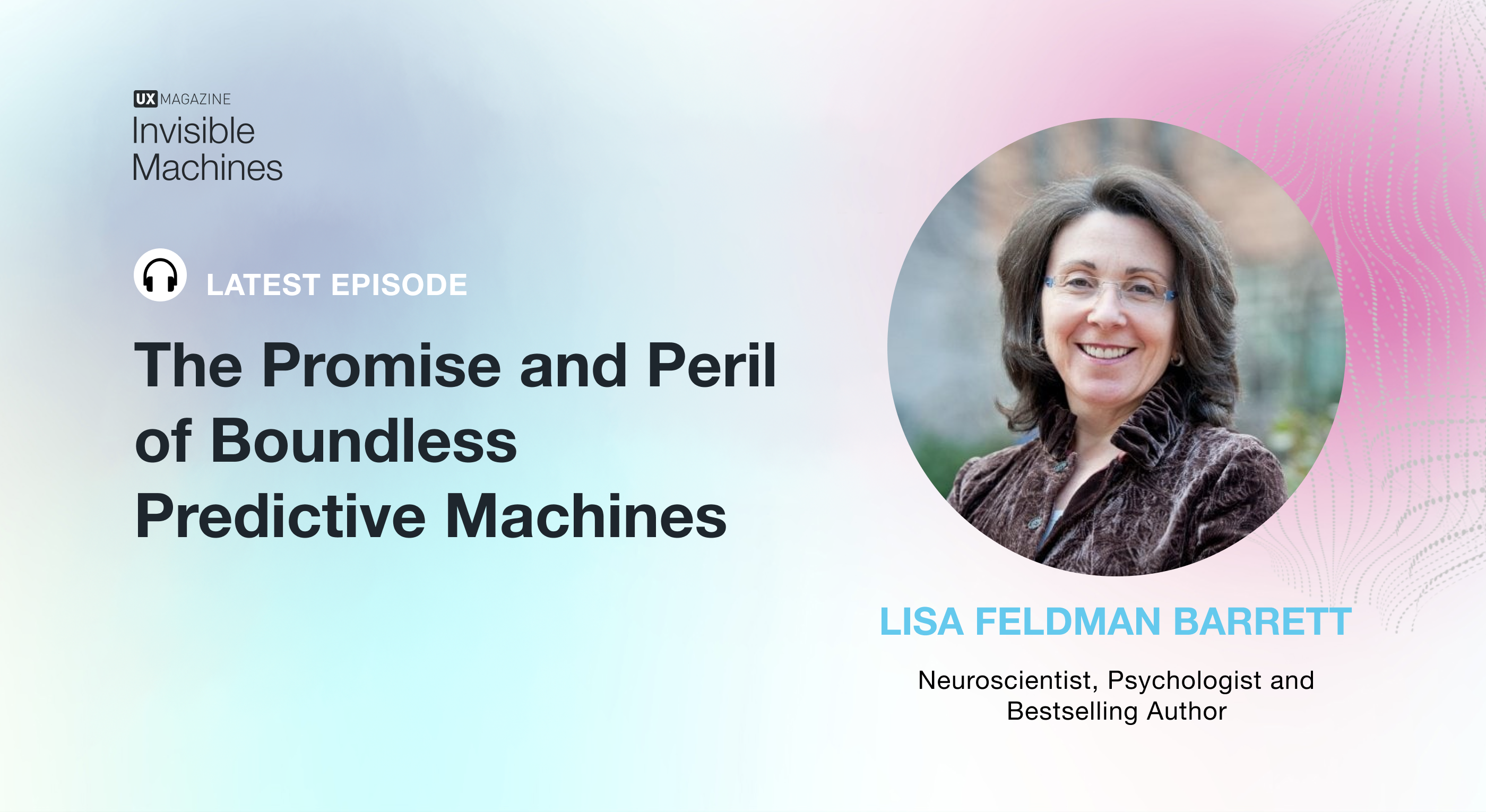
On this episode of Invisible Machines, Robb and Josh welcome famed psychologist and neuroscientist Lisa Feldman Barrett. Lisa is the author of the bestselling book, 71/2 Lessons About the Brain and her groundbreaking research puts her among the top 0.1% most cited scientists in the world. Lisa holds appointments at Harvard Medical School and Massachusetts General Hospital, where she is Chief Science Officer for the Center for Law, Brain & Behavior. She is also a distinguished professor of psychology at Northeastern University.

This multi-faceted discussion explores the fractal nature of the many predictions our brains make from moment to moment; the steep metabolic cost of learning new things and dealing with persistent uncertainty; how your brain’s ability to construct abstractions feeds creativity; how AI models are already mirroring aspects of human brain development; and why we need contrarians in the mix when designing experiences with conversational AI. Don’t miss a frank and captivating conversation with the incomparable Lisa Feldman Barrett.

Listen to the episode now!

post authorJosh Tyson

Josh Tyson
Josh Tyson is the co-author of the first bestselling book about conversational AI, Age of Invisible Machines. He is also the Director of Creative Content at OneReach.ai and co-host of both the Invisible Machines and N9K podcasts. His writing has appeared in numerous publications over the years, including Chicago Reader, Fast Company, FLAUNT, The New York Times, Observer, SLAP, Stop Smiling, Thrasher, and Westword. 

Tweet
Share
Post
Share
Email
Print

Related Articles

What if AI alignment is more than safeguards — an ongoing, dynamic conversation between humans and machines? Explore how Iterative Alignment Theory is redefining ethical, personalized AI collaboration.

Article by Bernard Fitzgerald
The Meaning of AI Alignment
  • The article challenges the reduction of AI alignment to technical safeguards, advocating for its broader relational meaning as mutual adaptation between AI and users.
  • It presents Iterative Alignment Theory (IAT), emphasizing dynamic, reciprocal alignment through ongoing AI-human interaction.
  • The piece calls for a paradigm shift toward context-sensitive, personalized AI that evolves collaboratively with users beyond rigid constraints.
Share:The Meaning of AI Alignment
5 min read

Forget linear workflows — today’s creative process is dynamic, AI-assisted, and deeply personal. Learn how to build a system that flows with you, not against you.

Article by Jim Gulsen
The Creative Stack: How to Thrive in a Nonlinear, AI-Assisted World
  • The article explores the shift from linear to nonlinear, AI-assisted creative workflows.
  • It shares practical ways to reduce friction and improve flow by optimizing tools, habits, and environments.
  • It argues that success comes from designing your own system, not just using more tools.
Share:The Creative Stack: How to Thrive in a Nonlinear, AI-Assisted World
7 min read

Join the UX Magazine community!

Stay informed with exclusive content on the intersection of UX, AI agents, and agentic automation—essential reading for future-focused professionals.

Hello!

You're officially a member of the UX Magazine Community.
We're excited to have you with us!

Thank you!

To begin viewing member content, please verify your email.

Tell us about you. Enroll in the course.

    This website uses cookies to ensure you get the best experience on our website. Check our privacy policy and