
Flag

We stand with Ukraine and our team members from Ukraine. Here are ways you can help

Get exclusive access to thought-provoking articles, bonus podcast content, and cutting-edge whitepapers. Become a member of the UX Magazine community today!

Home ›› Design ›› Most Read Articles of Q4 2022

Most Read Articles of Q4 2022

by UX Magazine Staff
2 min read
Share this post on
Tweet
Share
Post
Share
Email
Print

Save

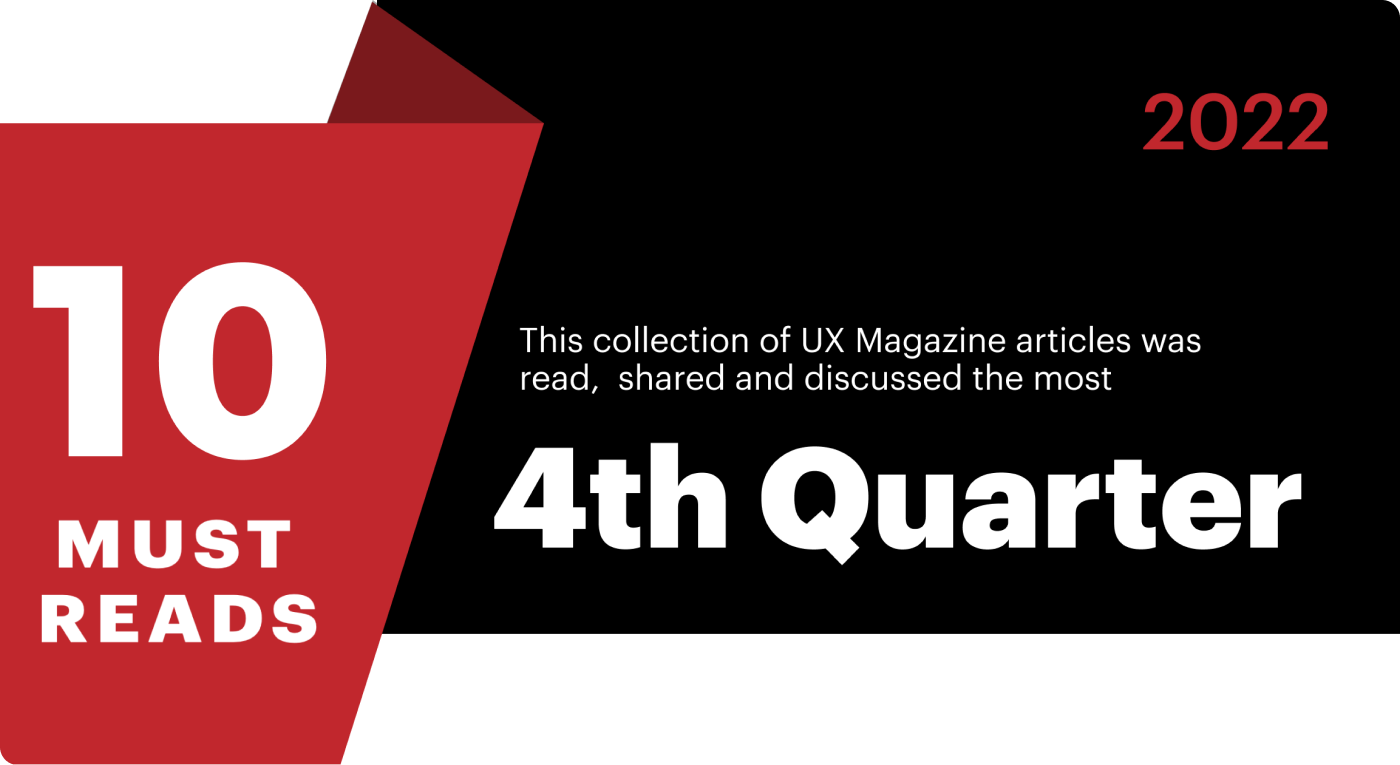
Here are the top 10 most-read UX Magazine articles in Q4 of 2022. This collection of articles was read, shared, and discussed the most.

Thank you to these 10 authors for contributing perspectives, ideas, and best practices that the UX Magazine community found helpful and engaging.

1. How Snapchat and Netflix Break UX Design Principles by Kumar Shubham

The principles of user experience are like the directions for a recipe but for great design. But who says there is harm in occasionally breaking them if it’s for a good cause? Read more in the article.

2. AI UX Design: A New Way Of Designing by Adam Fard

This article explains what AI-infused UX is and how to create products that employ AI. How can AI help designers do their jobs better? Learn more in the article.

3. User Stories vs Use Cases: How They Stack Up by Patrick Joseph Downs

What specifically distinguishes use cases from user stories? Are they not the same? It turns out that while having comparable goals, user stories and use cases are not nearly the same.

4. Building an Accessibility Library by Stephanie Hagadorn

While having tools like an annotation library can expedite the work of designers and developers, putting accessibility first when developing tools, methods, and procedures has far-reaching effects that go beyond accelerating the time to market. Discover more in the article.

5. The Evolution of Experience Design by Dan Ramsden

When new technologies appear, there are always threats and opportunities. And the arising challenges present the opportunity to genuinely architect experiences. Learn what current challenges and opportunities the design faces.

6. UI copy: Remove vs Delete by Alex Zlatkus

In the article, the author explains the difference between “remove” and “delete” options and how to ensure your user understands it.

7. Finding a balance between UX and SEO by Kristine Kalnina

Focusing on highlighting the right content is essential as UX and SEO have different requirements for high-performing content. Learn how to find this balance in the article.

8. Designing the Perfect Button by Domas Markevicius

One of the key UI components in the interactive design is buttons, and most organizations use button clicks to gauge their success. Everything you need to know about what makes a button great is in this article.

9. Creativity-based Research: The Process of Co-Designing with Users by Catalina Naranjo-Bock

Co-design workshops enable designers and users to collaborate so that their viewpoint is taken into account when new information, concepts, and products are developed. How to approach co-designing to gain the most? Learn from this article.

10. Top 5 Trends in User Research & Insights by Malini Leveque

The following list of five user research trends and highlights motivates global SAP User Research practice and provides teams with useful information to help them create quantifiable products that people like using.

Thank you to Kumar Shubham, Adam Fard, Patrick Joseph Downs, Stephanie Hagadorn, Dan Ramsden, Alex Zlatkus, Kristine Kalnina, Domas Markevicius, Catalina Naranjo-Bock, and Malini Leveque for writing such useful material.

Tweet
Share
Post
Share
Email
Print

Related Articles

Forget linear workflows — today’s creative process is dynamic, AI-assisted, and deeply personal. Learn how to build a system that flows with you, not against you.

Article by Jim Gulsen
The Creative Stack: How to Thrive in a Nonlinear, AI-Assisted World
  • The article explores the shift from linear to nonlinear, AI-assisted creative workflows.
  • It shares practical ways to reduce friction and improve flow by optimizing tools, habits, and environments.
  • It argues that success comes from designing your own system, not just using more tools.
Share:The Creative Stack: How to Thrive in a Nonlinear, AI-Assisted World
7 min read

How is AI really changing the way designers work, and what still depends on human skill? This honest take cuts through the hype to show where AI helps, where it falls short, and what great design still demands.

Article by Oleh Osadchyi
The Real Impact of AI on Designers’ Day-To-Day and Interfaces: What Still Matters
  • The article explores how AI is reshaping designers’ workflows, offering speed and support across research, implementation, and testing.
  • It argues that while AI is useful, it lacks depth and context — making human judgment, critical thinking, and user insight indispensable.
  • It emphasizes that core design principles remain unchanged, and designers must learn to integrate AI without losing their craft.
Share:The Real Impact of AI on Designers’ Day-To-Day and Interfaces: What Still Matters
9 min read

What if you could build software just by talking to your computer? Welcome to vibe coding, where code takes a back seat and the vibe leads.

Article by Jacquelyn Halpern
Vibe Coding: Is This How We’ll Build Software in the Future?
  • The article introduces vibe coding, using AI to turn natural language into working code, and shows how this approach lets non-coders build software quickly and independently.
  • The piece lists key tools enabling vibe coding, like Cursor, Claude, and Perplexity, and notes risks like security, overreliance on AI, and the need for human oversight.
Share:Vibe Coding: Is This How We’ll Build Software in the Future?
7 min read

Join the UX Magazine community!

Stay informed with exclusive content on the intersection of UX, AI agents, and agentic automation—essential reading for future-focused professionals.

Hello!

You're officially a member of the UX Magazine Community.
We're excited to have you with us!

Thank you!

To begin viewing member content, please verify your email.

Tell us about you. Enroll in the course.

    This website uses cookies to ensure you get the best experience on our website. Check our privacy policy and