
Flag

We stand with Ukraine and our team members from Ukraine. Here are ways you can help

Get exclusive access to thought-provoking articles, bonus podcast content, and cutting-edge whitepapers. Become a member of the UX Magazine community today!

Home ›› Business Value and ROI ›› 6 Key Questions to Guide International UX Research ›› Book Excerpt: The Digital Crown

Book Excerpt: The Digital Crown

by Ahava Leibtag
3 min read
Share this post on
Tweet
Share
Post
Share
Email
Print

Save

An excerpt from The Digital Crown explains the goal of effective content: users immediately recognize it, know it is for them, know what to do, and do it.

“Content Formats that Flex” is an excerpt from chapter three of The Digital Crown: Winning at Content on the Web.

We choose content formats in our own lives, often without thinking about it. Let’s say you receive an email from a colleague.

You read it, realize it’s a sensitive or complicated issue, and think, “I should really call this person back, not email him.”

You realize that the information you need to communicate may not be appropriate for an email.

That is an automatic, gut response; you probably don’t realize how you are flexing from one mode of communication to another, even as you are doing it. We choose which platform of technology is best to communicate our message; in other words, which content format works best—in this case written versus verbal.

Do you text or call a friend to let him or her know what time you will be at the restaurant? Think about it—you could call, but you know that will take longer than texting. The “Hi, how are you?” turns into a longer, perhaps unnecessary, conversation when all you really want to do is convey the information that you will be there at 6:00 p.m.

Recognizable Formats Attract Attention

We also exercise this flexibility when we choose, for example, to write a press release rather than a blog post. You write a press release because you know journalists immediately recognize a press release as a content format designed just for them. The format of the content communicates whom it is for immediately.

We don’t want our content and our conversations to feel like the Room of Requirement

Our audience has thousands of immediately recognizable content formats to look for/recognize/react to: Stop signs, customer reviews, prescription pads, report cards, medical forms, applications, and so on. Designed so we immediately recognize them and take certain actions, these content formats facilitate crisper interactions. Imagine the Internet without content formats? Overwhelming as it is now, it would be totally unnavigable.

THAT is our goal: We want our audience to immediately recognize the content, know it is for them, know what to do, and do it.

We don’t want our content and our conversations to feel like the Room of Requirement. We want the very opposite, in fact. We want them to feel like controlled experiences that help customers make decisions.

Content: Formats, Platforms, and Channels

There are probably hundreds of formats for content—there is no way we could list them all here. For the purposes of your content framework, however, I think we can look at the following divisions:

  • Text
  • Audio
  • Visual

In the following table, we differentiate information from content format, platform, and channel:
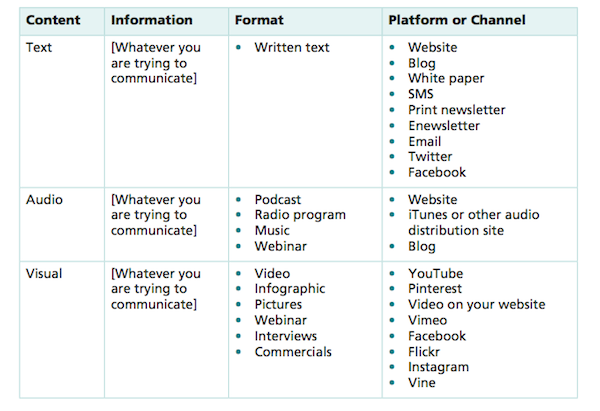
Table from chapter three of The Digital Crown

When you talk to people about content, they think you mean their website, as in the entire thing. But, as we know, content is not the website, it is what is ON the website, or in the book, or the subject of the video. You need to disassociate this idea that content is the same as the way it’s delivered to you. Content is not a magazine, or a TV program, or the mail. Rather, those are the channels through which you receive the content.

Your customers can encounter your content anywhere on the World Wide Web. You must divorce yourself from the idea that your content is tied to its point of origin—like your website—and instead think of your content as floating throughout the Internet, just waiting to fulfill a need for your target audience.

To read about all of the aspects of creating content experiences that wins with users, pick up a copy of The Digital Crown, using the discount code “SAVE3012” for 30% off the list price.

post authorAhava Leibtag

Ahava Leibtag

Ahava R. Leibtag has more than 15 years of experience in writing, messaging, and marketing. Her specialty is creating marketing campaigns designed to reach end-users, no matter how intricate the subject matter. Ahava is the Principal and owner of Aha Media Group, LLC, a full service Web consulting firm that has been in operation since October 2005. Clients include Johns Hopkins Medicine, Wake Forest University Baptist Medical Center, Washington Cancer Institute, Georgetown University Hospital, Franklin Square Hospital Center, and Montgomery General Hospital. She is the author of The Digital Crown: Winning at Content on the Web.

Ahava's position as a Communications Strategist for a government agency gave her unique perspective in writing customer-centric prose. Previously, she worked in the Corporate Communications department of Russell Reynolds Associates, a leading international executive recruiting firm. Ahava has also worked for two major advertising agencies and a commercial production company.

Tweet
Share
Post
Share
Email
Print

Related Articles

Forget linear workflows — today’s creative process is dynamic, AI-assisted, and deeply personal. Learn how to build a system that flows with you, not against you.

Article by Jim Gulsen
The Creative Stack: How to Thrive in a Nonlinear, AI-Assisted World
  • The article explores the shift from linear to nonlinear, AI-assisted creative workflows.
  • It shares practical ways to reduce friction and improve flow by optimizing tools, habits, and environments.
  • It argues that success comes from designing your own system, not just using more tools.
Share:The Creative Stack: How to Thrive in a Nonlinear, AI-Assisted World
7 min read

How is AI really changing the way designers work, and what still depends on human skill? This honest take cuts through the hype to show where AI helps, where it falls short, and what great design still demands.

Article by Oleh Osadchyi
The Real Impact of AI on Designers’ Day-To-Day and Interfaces: What Still Matters
  • The article explores how AI is reshaping designers’ workflows, offering speed and support across research, implementation, and testing.
  • It argues that while AI is useful, it lacks depth and context — making human judgment, critical thinking, and user insight indispensable.
  • It emphasizes that core design principles remain unchanged, and designers must learn to integrate AI without losing their craft.
Share:The Real Impact of AI on Designers’ Day-To-Day and Interfaces: What Still Matters
9 min read

What if you could build software just by talking to your computer? Welcome to vibe coding, where code takes a back seat and the vibe leads.

Article by Jacquelyn Halpern
Vibe Coding: Is This How We’ll Build Software in the Future?
  • The article introduces vibe coding, using AI to turn natural language into working code, and shows how this approach lets non-coders build software quickly and independently.
  • The piece lists key tools enabling vibe coding, like Cursor, Claude, and Perplexity, and notes risks like security, overreliance on AI, and the need for human oversight.
Share:Vibe Coding: Is This How We’ll Build Software in the Future?
7 min read

Join the UX Magazine community!

Stay informed with exclusive content on the intersection of UX, AI agents, and agentic automation—essential reading for future-focused professionals.

Hello!

You're officially a member of the UX Magazine Community.
We're excited to have you with us!

Thank you!

To begin viewing member content, please verify your email.

Tell us about you. Enroll in the course.

    This website uses cookies to ensure you get the best experience on our website. Check our privacy policy and